
REVIEW · JAPAN HOT SPRINGS
Kyoto: Traditional Concert at Townhouse or Bathhouse
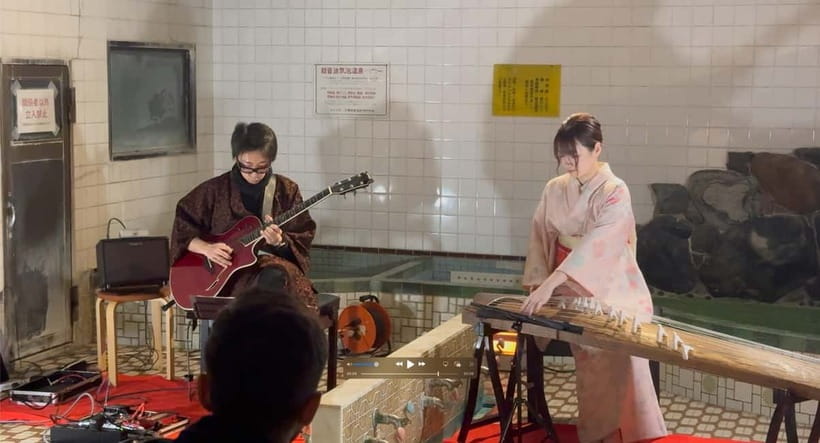
Kyoto’s traditional music is at its best when you can hear each plucked note fade into the room. This experience puts you close to professional koto and shamisen musicians, either in a small townhouse with room for about 11 people or in a former bathhouse hall with space for about 30. The music ranges from classical pieces to modern arrangements, and the hosts explain what you are hearing as you go.
I like the small audience, which makes the performance feel personal rather than ceremonial. I also like the hands-on koto workshop at the townhouse, where you learn to sit, pluck the strings, and play a short phrase. The main consideration is that the two venues offer different schedules: the townhouse runs almost daily, while the bathhouse program is held irregularly, usually on Mondays.
Key points to know before booking
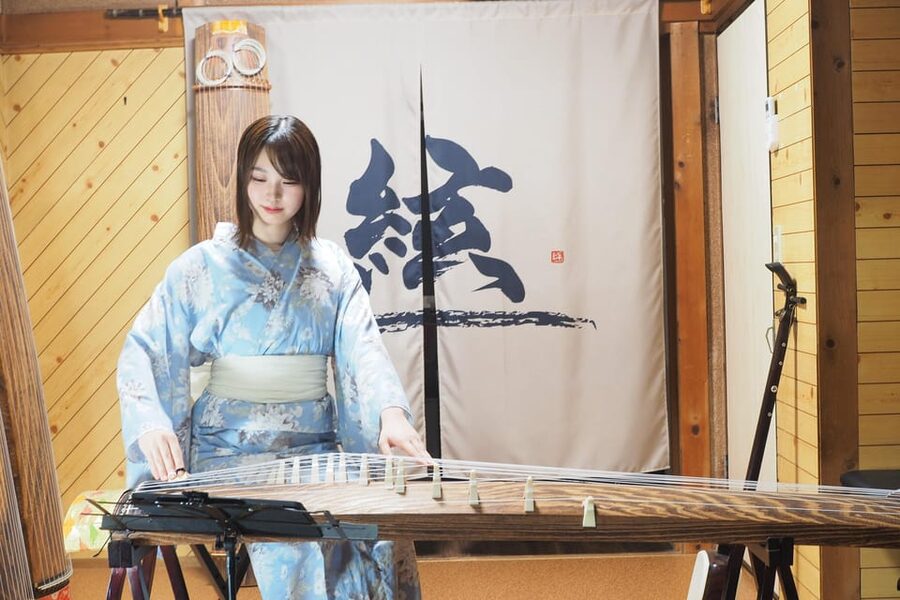
- Two very different settings: Choose a cozy solo concert in a Kyoto townhouse or a resonant duet program in a former bathhouse hall.
- Professional musicians: Hear koto and shamisen, with some bathhouse programs adding shakuhachi, flute, guitar, or taishōgoto.
- Useful bilingual explanations: Learn about the instruments, picks, bridges, notation, materials, and musical traditions in Japanese and English.
- Optional koto lesson: Townhouse bookings can include a 35 to 40-minute beginner workshop with sanitized instruments.
- Small groups: The townhouse holds about 11 people, while the bathhouse accommodates about 30.
- Good value at $32: You receive a live concert, commentary, Q&A, photos, and, at the townhouse, the option to add practical instruction.
A close-up introduction to Kyoto’s koto and shamisen
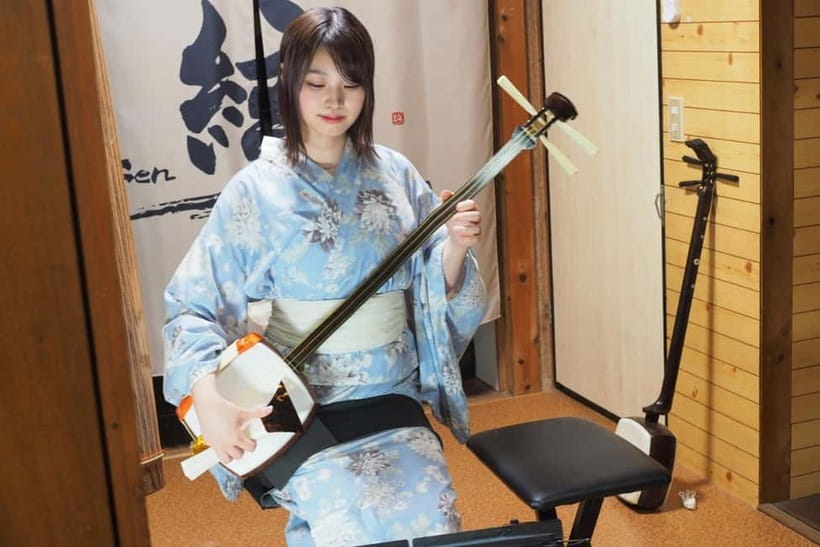
This is not a concert where you sit far from the stage and quietly wait for the program to end. The format brings the instruments close enough for you to watch the performer’s hands, picks, posture, and finger technique.
The koto is a long, harp-like zither with movable bridges beneath its strings. The shamisen is a three-stringed instrument played with a large plectrum. Their sounds are quite different. The koto can be delicate and flowing, while the shamisen has a sharper, more percussive voice. Some performers also sing, adding another layer to the program.
Before the music begins, the host introduces the instruments and explains how they are made and played. You hear about the parts of the instruments, the picks and bridges, and the special notation used for traditional music. This is useful because the music can otherwise seem mysterious to a first-time listener.
You do not need any previous knowledge of Japanese music. Most people arrive as beginners, and the short explanations give you enough background without turning the event into a lecture. Hosts such as Gen and Shohei have helped make the setting friendly and conversational, while performers including Furan, Aoi, and Kyoko have been praised for both their playing and singing.
Other hot springs and bathhouses people book in Japan:
- From Osaka: Himeji Castle, Arima Onsen & Mt. Rokko Day Tour
★ 4.6 · 339 reviews - Osaka: Nara and Uji Day Trip with Deer Park and Hot Spring
★ 4.4 · 302 reviews - From Tokyo: Private Tour to Fuji/Hakone – Onsen, Art, Nature
★ 5.0 · 116 reviews
Choosing between the townhouse and bathhouse
The traditional townhouse is the better choice if you want a quiet, personal encounter. It holds up to about 11 people, and some sessions are even smaller. The room has the feel of a Japanese living room, with cushions or chairs rather than formal concert seating.
The solo program usually includes four or five pieces. You may hear classical works, contemporary arrangements, and original compositions, depending on the performer and season. Titles such as Kajimakura, Chidorino Kyoku, and Kaede no Hana may appear, but the exact selection changes.
That changing program is part of the appeal. Each musician brings a different personality and choice of repertoire. One performer may focus on lyrical koto pieces and traditional songs, while another may show more of the shamisen’s rhythmic force. The program is designed to show range, not simply repeat the same short demonstration.
The townhouse is also the only venue with the optional koto workshop. If you want to do more than listen, this is the booking to choose. The workshop lasts about 35 to 40 minutes and is intended for complete beginners.
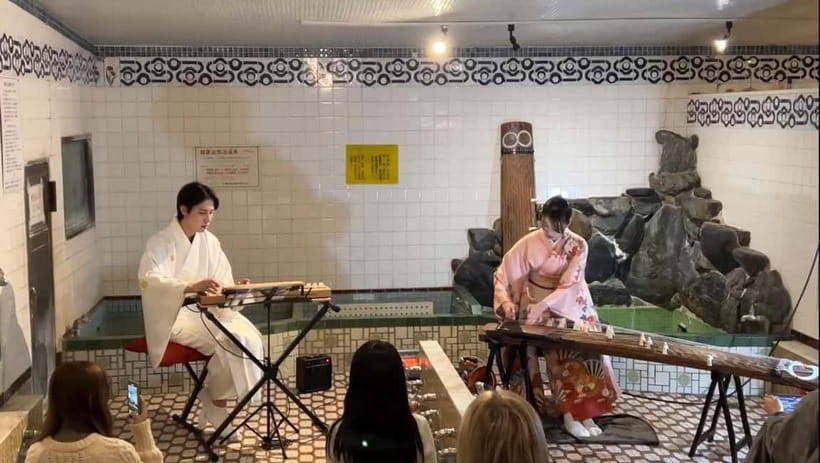
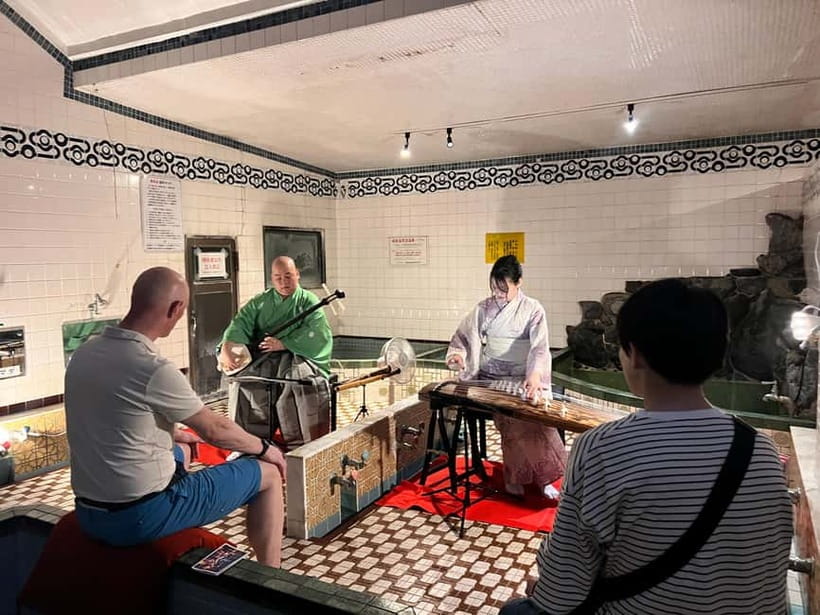
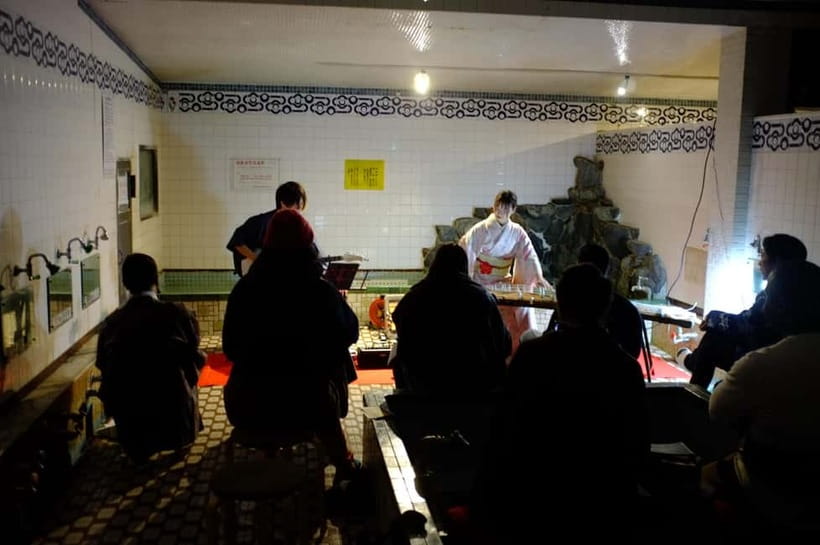
The historic bathhouse hall offers a larger and more dramatic sound. Its tiled walls create natural reverberation, so the notes hang in the air longer. This can make a duet feel enveloping, especially when the koto is paired with an instrument that has a contrasting tone.
Bathhouse programs feature the koto with another instrument. Depending on the date, that partner may be shamisen, shakuhachi, taishōgoto, flute, or guitar. The program generally combines solo works and duets across four or five pieces, not counting the opening introduction.
The bathhouse is the more interesting pick for anyone who cares about sound and musical combinations. It is less intimate than the townhouse, but the larger room gives the music more space. It is also less flexible for scheduling, since these performances take place irregularly on Mondays. Check the calendar carefully before planning the rest of your day.
One practical warning: the bathhouse is used as a performance venue here. Your ticket does not include bathing, food, drinks, or access to bathhouse facilities.
What happens during the 45 to 105 minutes
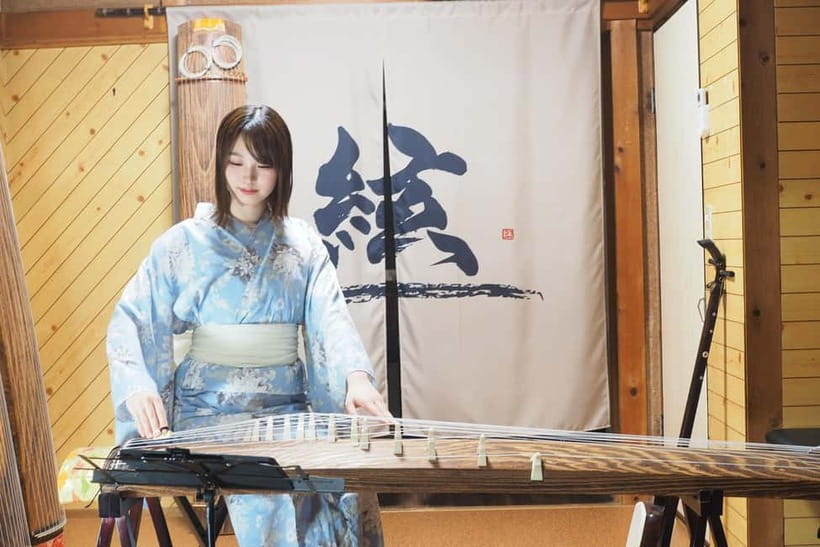
The length depends on the option you choose. A basic concert takes roughly 45 minutes to an hour, while a townhouse booking with the workshop can reach about 105 minutes.
Arrival and seating
Allow five to ten minutes for check-in and settling into the room. The hosts explain basic etiquette and help you find your place. In the townhouse, you may sit on a cushion or chair in a compact room. The bathhouse uses rows of seating.
The townhouse can be a little difficult to locate because it is away from the main tourist routes. Use the exact meeting information provided with your booking. One participant found map coordinates more useful than the street address, so it is wise to check your route before leaving your hotel.
More Hot Springs and Thermal Baths in Japan:
- Mt. Fuji, Hakone Private Tour from Tokyo – Onsen, Arts and Nature
★ 5.0 · 79 reviews - Tokyo: Mount Fuji 5th Station & Onsen Day Trip
★ 4.3 · 75 reviews - Private Nagano 1-Day Tour:Snow Monkeys,Zenko-ji,Obuse,Sake,Onsen
★ 5.0 · 71 reviews - Snow Monkey & Shibu Onsen Afternoon Tour (Depart: Iiyama & Nozwa)
★ 5.0 · 54 reviews
Instrument introduction
The introduction takes about 10 to 15 minutes. You learn how the koto and shamisen are held, how the strings are struck, and how the performer reads the music.
This section matters. Traditional Japanese notation does not look like the Western staff notation many people know, and seeing it helps you understand how the performer follows a piece. The host also explains the instruments’ materials and construction, which gives the concert more context.
The commentary is bilingual in Japanese and English. You should expect clear practical information rather than a long academic talk. That balance works well for a short Kyoto activity.
The concert
The main performance lasts around 25 to 30 minutes. The artist introduces the pieces and gives brief explanations between selections.
A typical townhouse program moves across several periods and styles. You might hear a classical work followed by a contemporary piece, then a traditional song with singing. That variety keeps the program from becoming a single long block of similar sounds.
At the bathhouse, the duet format changes the experience. Listen for the way the koto’s clean, ringing notes interact with the breath of a shakuhachi, the plucked attack of a shamisen, or the familiar tone of a guitar. The hall’s tiled surfaces add resonance, but they can also make the sound less close and dry than in the townhouse.
The program is best enjoyed with your attention on small details: the performer’s right-hand pick, the left hand pressing strings beyond the bridges, the pauses between phrases, and the way the voice blends with the instrument. You do not need to identify every musical form. Simply listening closely is enough.
Questions, photos, and conversation
After the concert, allow five to ten minutes for questions and photographs. You can ask about a piece, an instrument, the performer’s training, or the meaning behind a song.
This is one of the strongest parts of the experience because the group is small enough for a real exchange. The musicians and hosts are accessible, and the atmosphere is relaxed rather than formal. Photography is allowed during the designated photo time, so you can take a picture with the performer without interrupting the music.
The townhouse workshop is worth adding
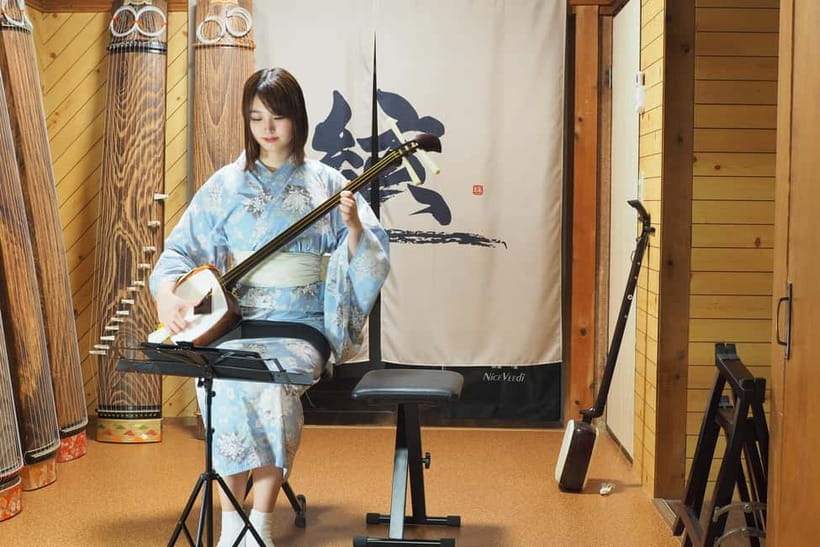
The optional workshop changes the activity from a concert into a short cultural lesson. You sit at the koto, learn how to position yourself, place the hand, and pluck the strings. With guidance, you play a short phrase.
Do not expect to become a koto musician in 40 minutes. The value is in understanding the physical work behind the music. After watching a professional performer move quickly and precisely, trying a few notes yourself gives you a new respect for the instrument.
The lesson is designed for beginners, including children old enough to follow the instructions. Instruments are sanitized, and the teaching is patient. One parent specifically appreciated the extra help given to a child during the practice session.
Choose the workshop if you enjoy participation and do not mind extending the visit. If you want a purely contemplative concert, the basic townhouse session is enough.
Why the small audience makes a difference
A compact room changes how you hear the performance. In a large theater, you notice the overall sound first. In the townhouse, you can watch the strings vibrate and see the performer’s hands make tiny adjustments.
The atmosphere is informal, but not careless. The host may use humor, answer questions, or draw the audience into a discussion. That can feel slightly unpolished at moments, especially if you expect a formal recital. I see this as a minor tradeoff for a more human encounter.
The room may feel crowded if the townhouse reaches its full capacity. Several people found groups of seven to nine especially comfortable. If you prefer personal space, ask about the group size when choosing your date, although the maximum is about 11 people.
The bathhouse avoids the townhouse’s tight quarters, but gives up some of that living-room feeling. Its seating and capacity make it closer to a small public concert. The reward is stronger acoustics and the chance to hear a duet.
Planning the concert around Kyoto sightseeing
The venues are useful stops for a west-central Kyoto day, but the meeting point varies by option. Confirm the location before setting out, and leave extra time if you are unfamiliar with the neighborhood.
From the Saiin area, you can reach Arashiyama in about 25 minutes. Walk to Saiin Station, take the Hankyu line to Katsura, and transfer to the Randen Line. This makes the concert easy to pair with a morning or afternoon in Arashiyama.
Nijō Castle is about 20 minutes away and can fit neatly before or after the performance. Kinkaku-ji is also roughly 20 minutes away, using a bus from Nishioji Sanjō followed by a short walk.
For food and shopping, Nishiki Market is about 25 minutes away by direct Hankyu service to Karasuma or Kawaramachi. This is a useful pairing if you want to eat before the concert, since food and drinks are not included.
The concert itself is not a full-day activity. That is good news in Kyoto, where schedules can become crowded quickly. Plan for 45 to 105 minutes, then build in transfer time between the venue and your next stop.
Is $32 a fair price?
At $32 per person, the basic concert is good value for a specialized cultural experience. You receive a professional live performance, bilingual commentary, a question period, photo time, and seating in a distinctive venue.
The price makes even more sense if you are interested in music, Japanese culture, or small-group activities rather than large sightseeing tours. You are not simply paying for 25 minutes of music. The explanation before the performance helps you listen with more understanding, and the close setting gives you access to details you would miss in a bigger hall.
The townhouse workshop adds the most practical value, since you receive direct instruction rather than only observing. If you are comparing the two venues, think of the choice this way:
- Choose the townhouse for intimacy, flexible dates, solo music, and the workshop.
- Choose the bathhouse for stronger natural reverberation, duet arrangements, and a more dramatic room.
- Choose based on the calendar first if your Kyoto schedule is tight, since the bathhouse dates are limited.
Free cancellation is available up to 24 hours before the activity, and you can reserve while paying later. That helps if you are arranging several Kyoto bookings around weather and transport.
Who will enjoy this most
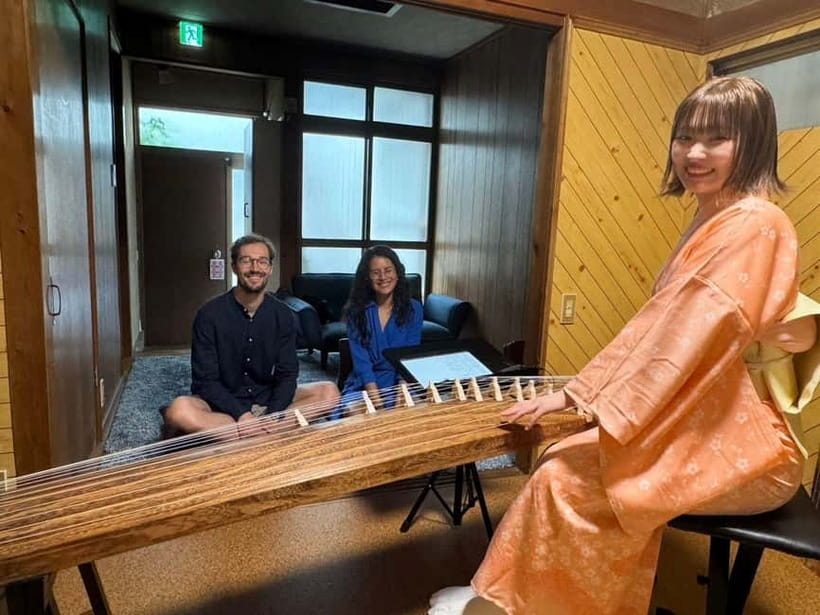
I would recommend the townhouse to first-time listeners of Japanese traditional music. The small room, English explanations, and optional lesson make it easy to follow.
It is also a strong choice for couples, families with older children, and anyone who wants a calm break from temple visits and crowded shopping streets. The music can be quiet and reflective, so it suits people who are willing to sit still and listen.
The bathhouse is better for returning visitors, music lovers, and anyone drawn to unusual venues or cross-instrument combinations. It is also a good choice if you have already seen plenty of solo performances and want to hear the koto in dialogue with another musician.
This may not suit babies under one year old. The experience also requires an interest in listening. If you want a fast, highly visual attraction, choose something else. The appeal here is sound, explanation, and close attention.
Should you book the Kyoto traditional concert?
Yes, if you want a personal introduction to Japanese music rather than another large sightseeing stop. The townhouse session is the safest choice for most people because it runs almost daily, keeps the audience small, and offers the optional workshop.
Book the bathhouse hall if the date works and you like the idea of a duet in a resonant tiled room. Just understand that it is less intimate and offered less often.
At $32, this is an easy activity to fit into a Kyoto itinerary. I would especially recommend it after a day of temples, markets, and train rides, when an hour of careful listening gives you a quieter view of the city. The townhouse, in particular, offers the kind of direct contact with musicians that is hard to find in a standard cultural show.
FAQ
How long does the Kyoto traditional music experience last?
The experience lasts between 45 and 105 minutes. A concert with the optional townhouse workshop takes longer than the concert alone.
What instruments can I hear?
The programs feature koto and shamisen. Bathhouse duets may also include shakuhachi, taishōgoto, flute, guitar, or another instrument, depending on the date and performers.
What is the difference between the two venues?
The traditional townhouse offers a small solo concert for up to about 11 people and includes the optional koto workshop. The historic bathhouse hall accommodates about 30 people and presents solo and duet programs with natural reverberation from tiled walls.
Is the experience offered in English?
Yes. The activity is conducted in Japanese and English, with bilingual commentary about the instruments, notation, and repertoire.
Do I need to know anything about Japanese music?
No. The introduction is designed for people with little or no previous knowledge of traditional Japanese instruments.
Is the koto workshop included?
The optional hands-on workshop is available for traditional townhouse bookings. It lasts about 35 to 40 minutes and teaches basic techniques and a short phrase.
Does the bathhouse ticket include bathing or food?
No. The ticket covers the concert, commentary, Q&A, photos, seating, and the townhouse workshop when selected. Bathing, food, drinks, and transportation are not included.
Freshly added soaks in Japan
- 1-Day Tour from Takayama: Unveiling the Charm of Gero Onsen★ 5.0 · 5 reviews
- Mount Fuji – Hakone & Onsen Full Day Private Tour★ 3.8 · 6 reviews
- Mt. Fuji, Hakone Private Tour from Tokyo – Onsen, Arts and Nature★ 5.0 · 79 reviews
- Himeji Castle, Arima Onsen & Mt. Rokko: 1-Day Bus Tour from Osaka★ 4.0 · 28 reviews
- Osaka: Tennen Onsen Naniwa-no-Yu, the famous hot spring spa★ 4.7 · 19 reviews
- Osaka: Solaniwa Onsen Hot Spring Visit★ 4.6 · 51 reviews
- Snow Monkey & Shibu Onsen Afternoon Tour (Depart: Iiyama & Nozwa)★ 5.0 · 54 reviews
- 1-Day Winter Tour From Nozawa Onsen: Snow Monkeys, Zenko-ji Temple & Sake★ 5.0 · 32 reviews
Japan Hot Springs, compared.
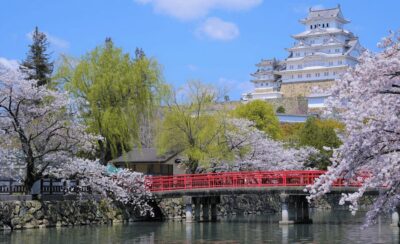
Himeji Castle, Arima Onsen & Mt. Rokko Day Tour
Read our review →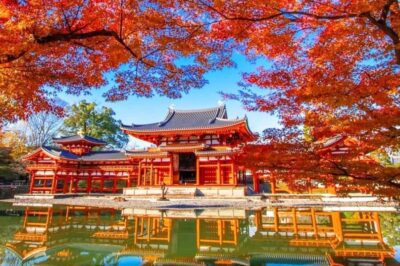
Nara and Uji Day Trip with Deer Park and Hot Spring
Read our review →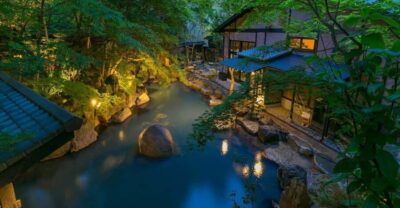
Private Tour to Fuji/Hakone – Onsen, Art, Nature
Read our review →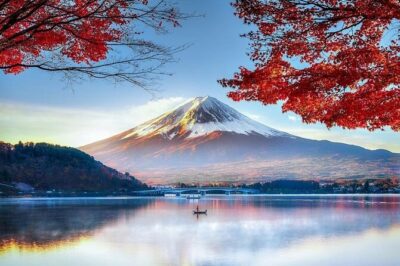
Mt. Fuji, Hakone Private Tour from Tokyo – Onsen, Arts and Nature
Read our review →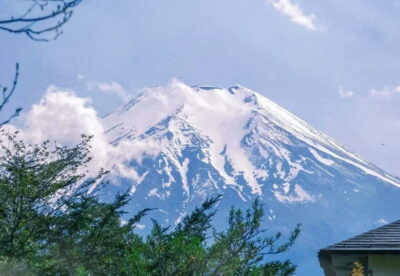
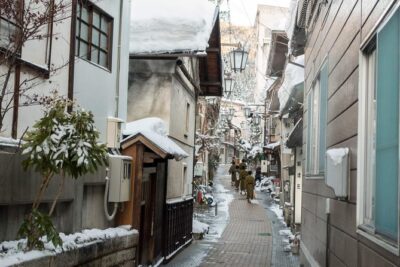
Private Nagano 1-Day Tour:Snow Monkeys,Zenko-ji,Obuse,Sake,Onsen
Read our review →
Snow Monkey & Shibu Onsen Afternoon Tour (Depart: Iiyama & Nozwa)
Read our review →![[Seasonal Limited] Mt. Fuji 5th Station &Hot Spring Day Tour](https://m2.hotspringtravels.com/wp-content/uploads/seasonal-limited-mt-fuji-5th-station-hot-spring-day-tour-400x225.jpg)
[Seasonal Limited] Mt. Fuji 5th Station &Hot Spring Day Tour
Read our review →More soaks worth the detour